|
In 2010 the American Bar Association Criminal Justice Section launched the Racial Justice Improvement Project (RJIP), with support from the Bureau of Justice Assistance (BJA). The RJIP was originally a two-year federally funded initiative designed to identify and reform policies and practices that produce racial disparities in local criminal justice systems across the country. Currently, the RJIP has selected a task force for Delaware (statewide); St. Louis County, Minnesota; Kings
County, New York; and New Orleans, Louisiana to receive financial support and technical assistance to implement a local racial justice improvement task force focused on addressing problems that contribute to the racially disparate impact of the criminal justice system. The project has since been refunded by BJA for an additional two years to support four additional jurisdictions joining this reform effort.
Our four additional task force groups, recently chosen by RJIP Advisory Board, will be announced in mid-April 2013. View our Request for Proposal for more information Request For Proposal (RFP) |
|
Each of the current task force groups have identified a racial disparity within their local criminal justice system and have begun working on a policy reform that could reduce or eliminate that disparity without any change in law or legislative enactment.
DELAWARE The Delaware task force has focused its reform efforts on the disproportionate number of African Americans that are subject to probation revocation. NEW ORLEANS The New Orleans, Louisiana task force has worked on expanding the number of minorities eligible to participate in the District Attorney’s pretrial diversion program and increasing the capacity of the diversion program to serve the growing local Latino community. In addition, the Task Force is currently in the planning stages of creating an accelerated diversion program for defendants charged with nonviolent first time property crimes. NEW YORK The Kings County, New York task force is focusing on addressing racial disparities that exist among minority juveniles. The task force has created a juvenile diversion program utilizing a curriculum provided by the Center for Court Innovation. The task force is also working to develop implicit bias training for judges and attorneys. MINNESOTA The St. Louis County, Minnesota task force is addressing the over-representation of African American and Native American arrestees in pretrial detention and the disparate (higher) bail imposed on individuals from these ethnic groups. |
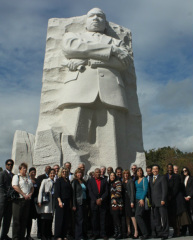
![]() The Racial Justice Improvement Project is proud to announce it is the 2011 recipient of the ABA SOC Meritorious Service Award. The award is given each year to a project that demonstrates outstanding commitment and work. Pictured above is Jack Hanna, Criminal Justice Section Grant Director; Kim Ball, Bureau of Justice Assistance Policy Advisor; Cynthia Jones, Racial Justice Improvement Project Former Director; Salma S. Safiedine, Racial Justice Improvement Project 2012 Director. |
While minorities have a higher rate of criminal activity in some crime categories, this does not explain why minority defendants who commit the same crimes and have the same criminal history as white defendants are more likely to be denied pretrial release, and are sentenced more harshly. Likewise, while there are some bad actors in the criminal justice system whose professional judgment is affected by racial bias, “race neutral” laws that are fairly and evenly enforced across all racial groups, can still have a disparate impact on minority defendants. The RJIP's purpose is to work with officials in state and local criminal justice systems to identify the discretionary decision points in the adjudication process where policies and practices have an adverse impact on minorities, and to develop evidence-based policy reforms to correct these racial disparities. An essential component of this policy reform initiative is having the work of each task force developed and implemented under the watchful eye of the top criminal justice officials in each jurisdiction, all of whom have the ability to make and change policies and practices, and the expertise needed to successfully implement reforms. Each task force, in each of the four originally chosen jurisdictions (and new addiitonal four jurisdictions) is composed of the district attorney, the chief public defender, the police chief, the chief judge of the criminal court, and a representative from a community organization that focuses on criminal justice reform.
This website is funded in whole or in part through a grant from the Bureau of Justice Assistance, Office of Justice Programs, U.S. Department of Justice. Neither the U.S. Department of Justice nor any of its components operate, control, are responsible for, or necessarily endorse, this website (including without limitation, its content, technical infrastructure, and policies, and any services or tools provided).